


Author:
Expert
If you are a fan of golf on any level, you’ve almost certainly heard the term ‘links’ used in reference to a golf course before. Whether this has been on TV, in the office, or listening to your mates talking about the latest golfing event, more than likely it has come up. Many of you may even be avid golfers that have never played links golf before or simply can’t wrap your head around what exactly defines a true links golf course. Well, we’ve all been there at some point or an other, so we’re going to attempt to set the record straight here once and for all (maybe)!

Dumbarnie Golf Links (Photo by Ryan Caven)
What is a True Links Golf Course?
Before we go into too much detail, let's get straight to the point:
A true links course is located alongside the sea. It has sandy soil and little vegetation besides tall sea grasses and gorse (a hearty, low-growing, evergreen plant). The natural terrain is used to develop the golf holes. An important reason the game of golf originated on this type of land was because it suited play. Course designers had limited resources for moving earth to shape the course and many of the bunkers were once natural, windswept dunes. The layout of the holes is also a part of a true links course with the first 9 going out to the farthest point from the clubhouse and the second 9 bringing you back in (OUT & IN).
Noble Beginnings
Golf allegedly originated somewhere on the eastern coast of Scotland.
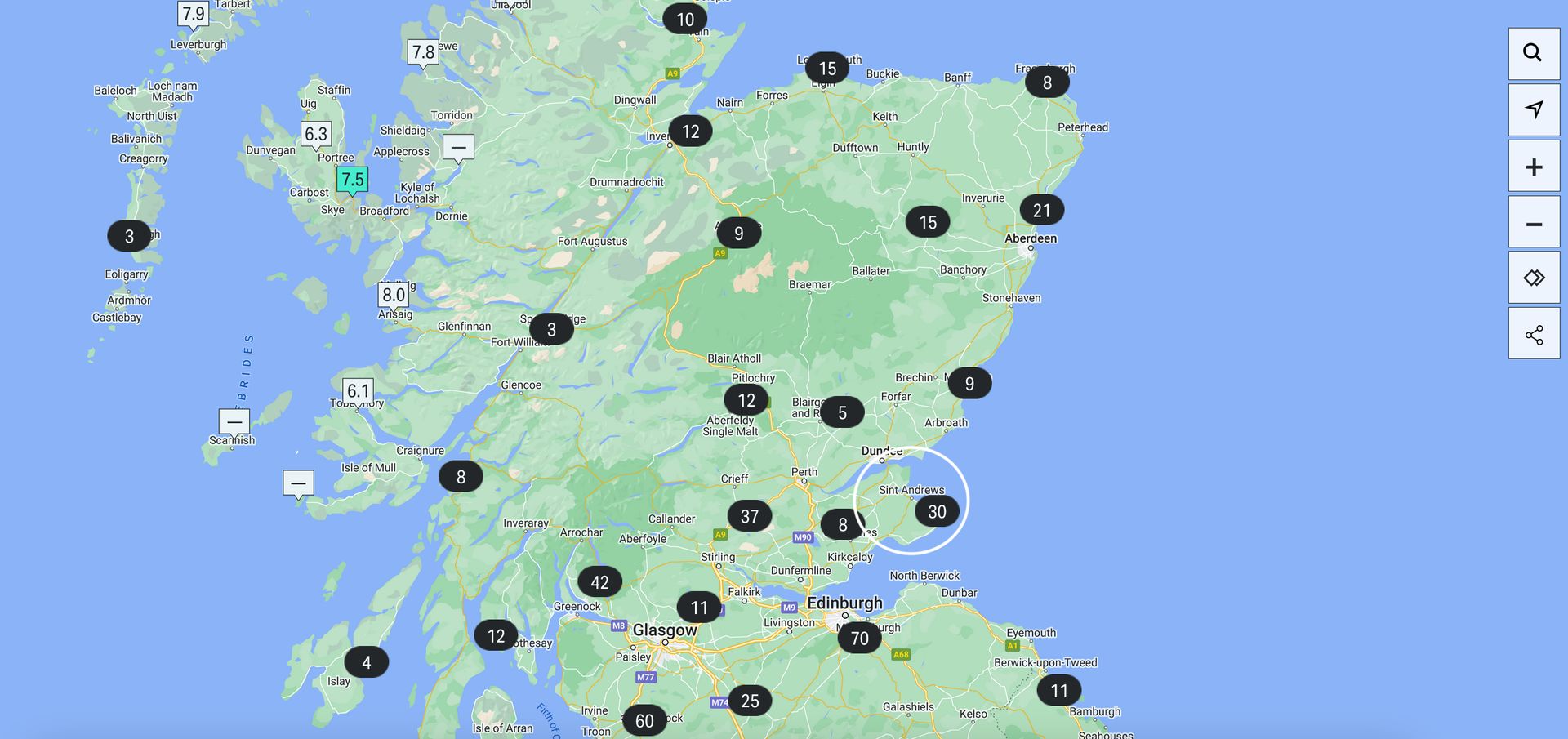
Now let’s go back to the beginning of the sport to understand the meaning fully. It is believed that the game of golf originated somewhere on the eastern coast of Scotland. There are a few stories (some more entertaining than others) flying around about how exactly the game was initiated, but it seemed to have evolved from the reign of Julius Caesar. However, we’ll save you a few superfluous details and jump to the 15th century (around 1457) when the Scottish Parliament first recognised the ‘modern’ game of golf. This recognition came about as a result of King James II actually banning the game. The story goes that the sport was distracting Scottish soldiers from preparation for a looming invasion by the English!
A Links Golf Course

Hole 15 at Pennard Golf Club (Photo by Pennard Golf Club)
Why the history lesson you ask? Well, you may have noticed from above that the game of golf originated on the coast of Scotland – this in turn brought the term links. The word itself has evolved from the Old English word ‘hlinc‘ – meaning ridge or rising ground. This described the type of hilly land found in the coastal regions of the UK. This land is usually pretty rugged, sandy underfoot, remarkably undulating and extremely windy. These conditions result in a scarcity of tree growth and tall, thick, rough native grasses that define the land. These qualities also define a links golf course.
What Makes A Links So Special?

The infamous lighthouse at Trump Turnberry Resort (Photo By Trump Turnberry Resort)
The three primary styles of golf courses are links, parkland and desert. Out of all these styles, links golf is the oldest – dating back to the start of the game. It is commonly known that links courses are more difficult for golfers to play. This may be due to the harsh weather conditions they can experience or simply the layout of the course. It has been said by many that links courses are the true test of a golfer’s ability. True links golf courses are demanding, and unforgiving and have the external elements that make playing golf far more challenging than a desert or parkland course.
The difference between a links golf course and a regular course is that the golfer is forced to work with the natural elements of the course. The links course is not manufactured and maintains the original lay of the land. This emulates how it was in the earliest days of the game. Even if a player knows the course well, it is notoriously unpredictable, so factors such as creativity, risk and luck all come into play (oftentimes as much as skill).
A True Links Golf Course

As any good traditional links is bordered by a railroad (Photo by Graeme McCubbin from Links Diary)
The definition of a links golf course has developed and altered down through the years and that may be why there can be confusion today. Even amongst the best in the game, there is conflict over what defines a true links course. Today, a links golf course is more broadly defined as a golf course with a natural and open layout, lying on sandy soil that is heavily affected by the wind. It has few to no trees but with thick rough grasses. The course features several bunkers, with many of them being deep, pot bunkers – to prevent the sand from blowing away. And of course the traditional ‘OUT’ and ‘IN’ routing, so 9 holes out and 9 holes coming back to the clubhouse.
Another thing that is typical of a links-style course is the hard ground. This is due to the lack of moisture retained by the sand-based turf. The ball will generally roll further than on a normal course. You can make this work quite well for you if you’re up to it. They call this a ‘bump and run’.
Playing a Links Golf Course

15th Hole at Trump International Doonbeg (Photo by Trump International Doonbeg)
Playing links golf courses can be testing for all golfers from the first-timers to the pros. You really have to think about your shot when playing links golf. However, the beauty of it is that once in a while your ball can hit the right bounce, the wind can be your friend or the bunkers can show you mercy (but don’t count on it).
We’ve come up with a few basic tips to keep in mind if you ever find yourself on a blustery tee box by the sea:
1. Make the wind your friend – tougher than it sounds
2. Tee the ball low and address the ball middle of your stance
3. Play it low! – punch the ball or you may see it coming back for you
4. Distance putting – sometimes from off the green
5. ‘Bump and run’ the ball – the hard ground will allow for this
6. Use hybrid clubs – lighter and more control
7. Play it safe when your ball is in the bunker – you’re no Tiger
8. Check your ball – some golf balls perform better in the wind
We hope these ideas are helpful but don’t hold us to them. After all, the whole love affair with the links is based upon its unpredictability.
Where to Play Links Golf?
So now that we’ve defined a links golf course and hopefully helped you out on the course, it’s time to learn where in the world you can play. This brings us to another reason why the links course is so unique – there are not that many of them!
According to the ‘The Links Association’ there are only 246 true links courses in the world at the minute. Most of these can be found in the UK and Ireland although there are quite a few in New Zealand, Australia and North America. Some golf courses claim to be links courses, however, that’s not always guaranteed. A golf course at the coast doesn’t mean that it is a true links course. It must have all of the elements described above, namely; built on natural links land and maintaining the specific design/layout.
The Old Course at St Andrews Links
The Old Course at St Andrews Links in Fife, Scotland, is the oldest and most iconic golf course in the world. Evidence that people played on this golf links can be traced back to the year 1552. The Swilcan Bridge and Hell Bunker are recognised across the globe, yet the greatest feature of the Old Course is that despite its grand status it remains a public golf course, open to all.
Read our blog on The Old Course here!
/990_1681330408.657.jpg?v1)
/990_3015afb1-76a7-4fb1-b51b-261a090f56ac.jpg?v1)
/990_f9ce86c3-1f5c-4def-9807-e170786dd13a.jpg?v1)
/990_e3de4cc8-99d5-4cbc-bd7d-654194ae0f2b.jpg?v1)
/990_db83c96a-4401-413d-ab2e-c06b1da85308.jpg?v1)
Royal County Down
Royal County Down Golf Club is located in one of the world’s most naturally beautiful links settings in the Murlough Nature Reserve, Northern Ireland. The ‘bearded’ bunkers are world famous and feature overhanging lips of marram, red fescue and heather. The greens are fast and many are domed, rejecting any shot lacking conviction. This is a true test of any player’s command of the traditional ‘bump and run’, the preferred way to play any links.
Read our blog on Royal County Down here!
/1647_1388764753.165.jpg?v1)
/1647_ff8b867f-7faf-43fe-881a-02165a74d65e.jpg?v1)
/1647_bbc8cab8-3a16-4a3e-be90-6cb908e58c98.jpg?v1)
/1647_ba5da7cc-1c4f-46fc-9714-70c075f9efa0.jpg?v1)
/1647_b053e165-020b-4407-9a84-e462026f8d83.jpg?v1)
Royal St George’s
The Royal St George’s Golf Club is located in the quaint English seaside town of Sandwich in Kent. The club has a distinguished golfing history and is proud to have hosted amateur and professional tournaments since the 1880’s. This golf club is one of England’s finest links courses and has played host to The Open Championship fourteen times with a fifteenth scheduled for 2020.
Read our blog on Royal St. George’s here!
/2857_1393401391.223.jpg?v1)
/2857_f1affbe7-80e8-4865-9537-291a3356bef9.jpg?v1)
/2857_ee9a109e-a4e7-437e-b0f7-b3eeff2d578a.jpg?v1)
/2857_dea0c6c5-a65c-4a85-9b34-286d15b80ab4.jpg?v1)
/2857_d80cdca7-14a8-4e8d-8209-83e903f6f532.jpg?v1)
Ready to Play!
So there you have it. You are always going to get a few arguments from others as to what exactly a ‘true links golf course’ is, but that’s all part of the fun. The main thing is that you are enjoying your golf, whatever level you’re at and wherever you play. And don’t forget, if you’re looking for courses around the world, check out Leadingcourses.com and search for your desired destination. Happy Golfing!
About the author
Related articles


Find a golf region
Most popular spots for golf
Spain
Golf courses in BarcelonaGolf courses in MadridGolf courses in MarbellaGolf courses in MálagaGolf courses in SevilleFrance
Golf courses in CannesGolf courses in Cap d'AgdeGolf courses in Chamonix-Mont-BlancGolf courses in NiceGolf courses in ParisPortugal
Golf courses in AlbufeiraGolf courses in LagosGolf courses in LisbonGolf courses in PortimãoGolf courses in PortoItaly
Golf courses in FlorenceGolf courses in MilanGolf courses in NaplesGolf courses in RomeGolf courses in VeniceTop blogs


Copyright © 2007-2026 — leadingcourses.com